


Disclaimer: I’ll be offering my opinions on the merits of currently available LEGO and non-LEGO train track elements. This will be mainly from a theoretical perspective, as I haven’t had personal experience of most of these. I own some lengths of straight track from BlueBrixx, as well as a selection of Fx Track straights, curves and points, which I chose in particular for their appearance. I haven’t used track from any other third parties, and haven’t used LEGO track since the blue era.


I’ve probably written enough recently about the scale of LEGO trains, so my only nod in that direction here will be to note from the outset that LEGO track elements, and even the best LEGO-compatible curves and points from third parties, are wildly tighter and wigglier than anything you’ll find on most real railways. Consider these specs:
- ‘The limiting design values for curve radii shall [at the tightest extreme] exceed 14 standard baseplates.’
- ‘A length of straight track at least 10 studs long shall be provided between [a pair of] reverse curves if one of the curves has a radius of less than 18 baseplates.’
- ‘All passenger lines, and freight only lines adjacent to passenger lines, with a horizontal radius of 22 baseplates or less shall be fitted with a continuous check rail to the inside rail of the curve. Check rails shall extend at least 1 baseplate into the straight or circular curve adjacent to the section of track with a radius of 22 baseplates or less and its associated transitions.’
Those are quotes from the UK Railway Group Standard GCRT5021 ‘Track system requirements’ (issue 6, December 2023), apart from the bits in bold, which are my rough translations of measurements in metres to LEGO studs, or standard baseplates (32 studs), scaled from the track gauge. LEGO curves miss out on meeting the minimum requirement by an order of magnitude!
That said, I think it’s still possible to give a good impression of realism with the train track that we have available to us, especially using larger-radius curves from third parties. What follows isn’t about scale at all – it’s just a pity that neither LEGO nor any third party (to my knowledge) offers straight or curved track elements with check rails (which we might as well always use!).
Straight
No, not me. 😉
Since LEGO’s first proper train set appeared – the year before I was born – the toymaker has sold straight track sections that are 16 studs long. Sort of, anyway. The first straight track (in the ‘blue era’) had to be built from white 2-by-8 plates-as-sleepers (US ties) and separate 16-stud-long rail pieces (which were blue, hence the name). But since 1991, with the introduction of 9 V powered track, LEGO straight track has looked pretty much like it does today (though it no longer has metal rails). (LEGO YouTuber Minifig Jez has a nice overview of the history, or you can read LEGO’s own account of its trains through the years.)


LEGO has a one-size-fits-all policy, so if you need a shorter length of straight track, you can simply cut it – sorry! – you can often find what you need from makers of LEGO-compatible track. Short straights (especially those in fractional stud lengths) can be very useful for subtle corrections to track geometry. (Double- and triple-length straights are available too, making long straight sections of track easier to build.)
For completeness I’ll mention LEGO’s flexible track here, as it can act as a 4-, 8- or 12-stud straight. Using it for longer stretches seems inadvisable if you can avoid it, as it’s much noisier than ordinary track, prone to causing derailment, and relatively ugly too. (It could make some nice greebling on the outside of a building though!)


Besides the 16-stud straight, LEGO offers just one curve and one set of points, in left-handed and right-handed variants.
Curved
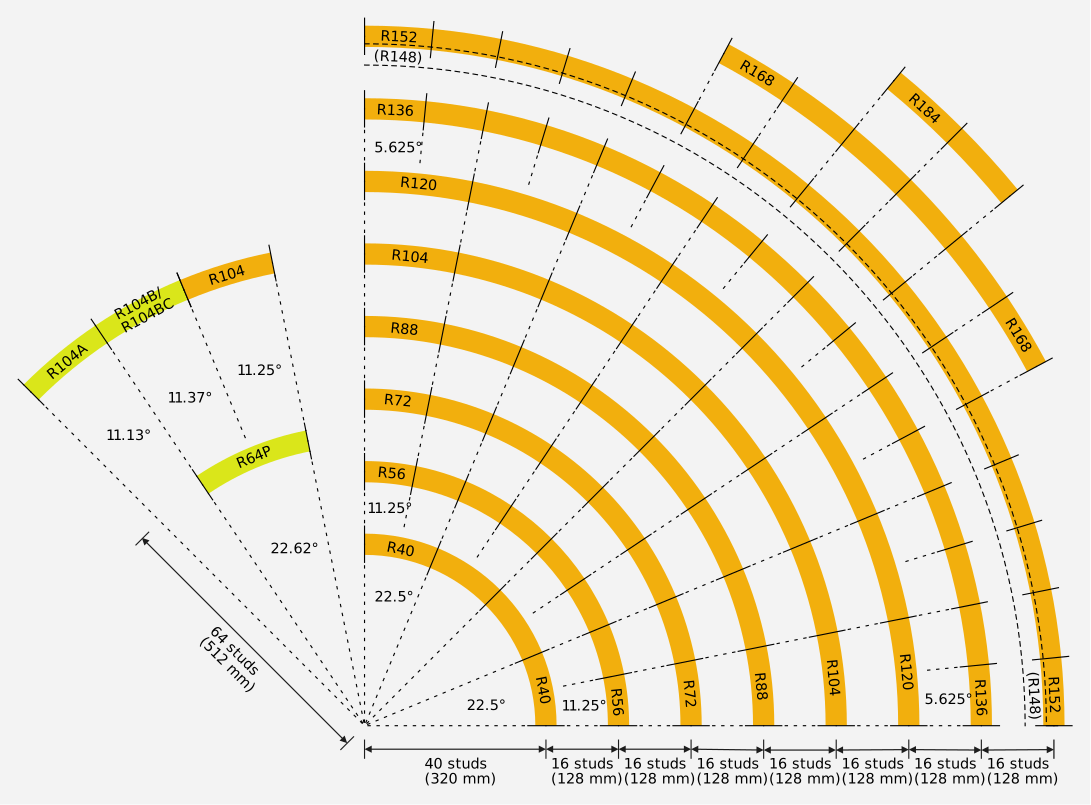
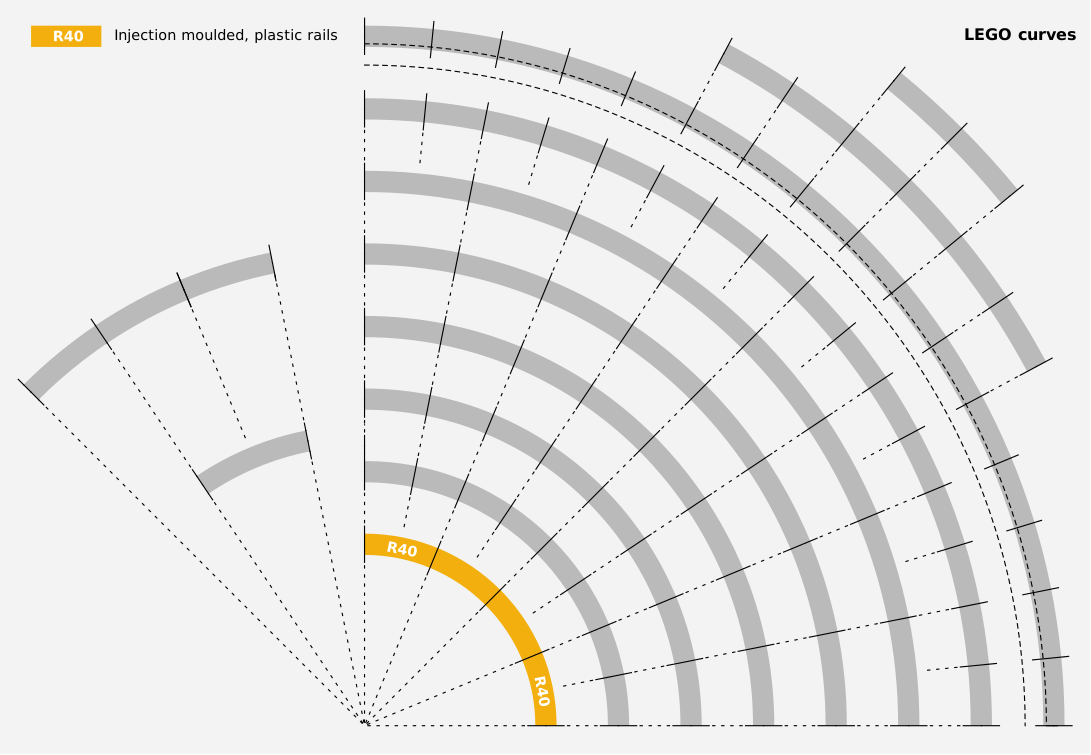
LEGO’s one curve, with its radius set in ABS since 1966, is commonly referred to as an R40, that is, a curve of radius 40 studs. (Note that the measurement of radius is to the centreline of the curve. Add 4 studs for the outer edge; subtract 4 for the inner edge.) More specifically, LEGO’s R40 forms 22.5 degrees of arc of a 40-stud circle.
While every train that LEGO has produced can traverse such a tight curve, turning 90° within the confines of an L shape made from three 32×32 baseplates (or if you prefer, within a single 48×48 baseplate), larger trains will struggle, and most trains would appreciate a little extra space. If you have the physical room for it, breathing space for your trains is at hand in the form of a bewildering array of compatible curves from third parties, as shown below. All the way up to R184 (which would produce a circle a little over 3 m in diameter!).
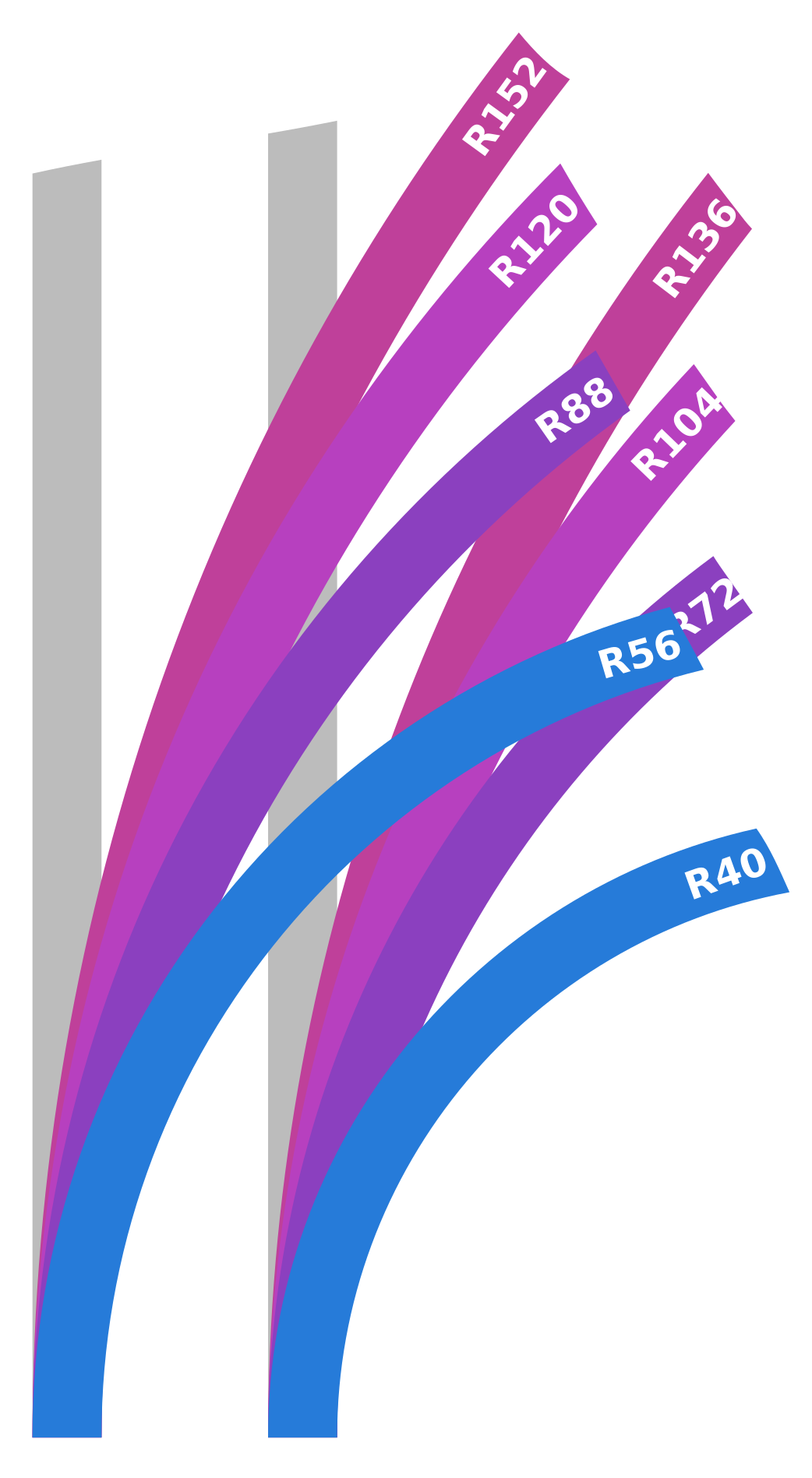
As you can see from the diagram, as you work outwards from one curve to the next, the radius usually jumps by 16 studs. This means that adjacent pairs work very nicely for bends in parallel tracks at a 16-stud spacing. The L-gauge modular standard, should you choose to follow it, specifies the normal position of straight tracks on standard baseplates (or MILS plates) as being 4 studs in from each edge, with 8 studs between, that is, 16 studs between centres.

Incidentally – I do love a tangent! – baseplates as we know them didn’t appear until 1978 (a little too late for me to have come across them as a child). According to BrickLink, there were four sets that year that included this new element, one being set 165, the goods station, probably the first time tracks were pinned down to a baseplate. This was still firmly in the blue era, and the two tracks on the grey baseplate were positioned at LEGO’s then-preferred spacing of 8 studs centre-to-centre, with sleepers butting up against each other. Fine if you only have six-stud-wide trains and no parallel curves – certainly a great space saver anyway.
I’ve looked at the descriptions of track from LEGO and from six alternative sources, and nerded out on their specs so that you don’t have to – unless you really want to, of course, which if you’re reading blog posts about LEGO by me, you probably do.
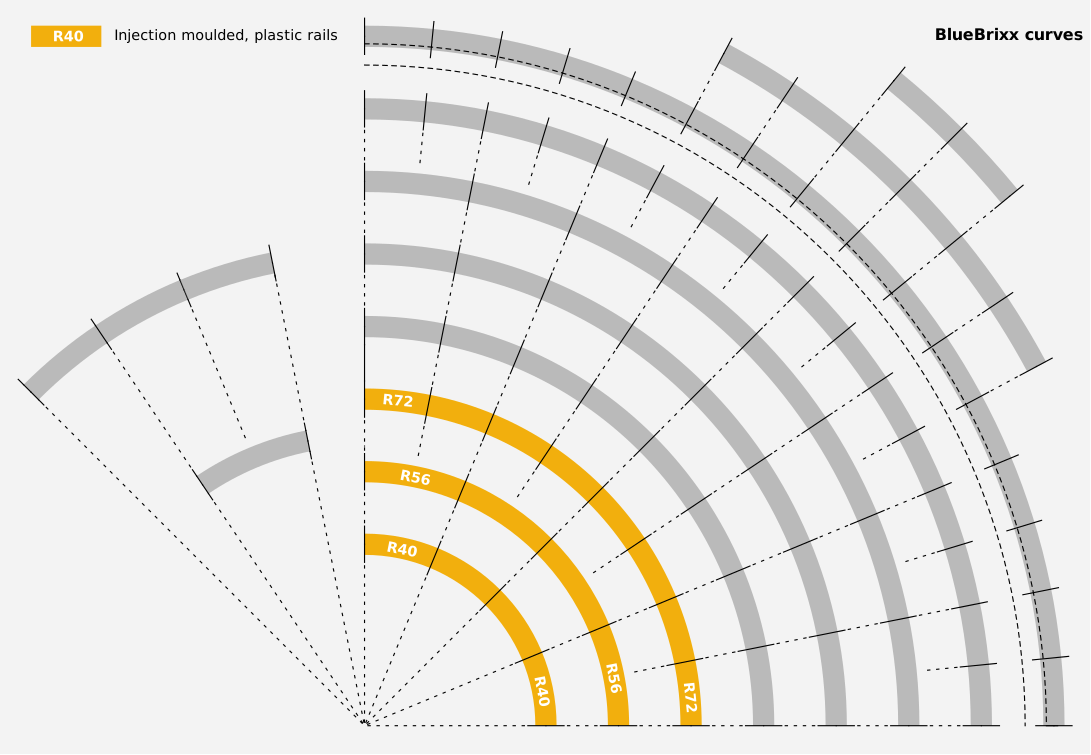
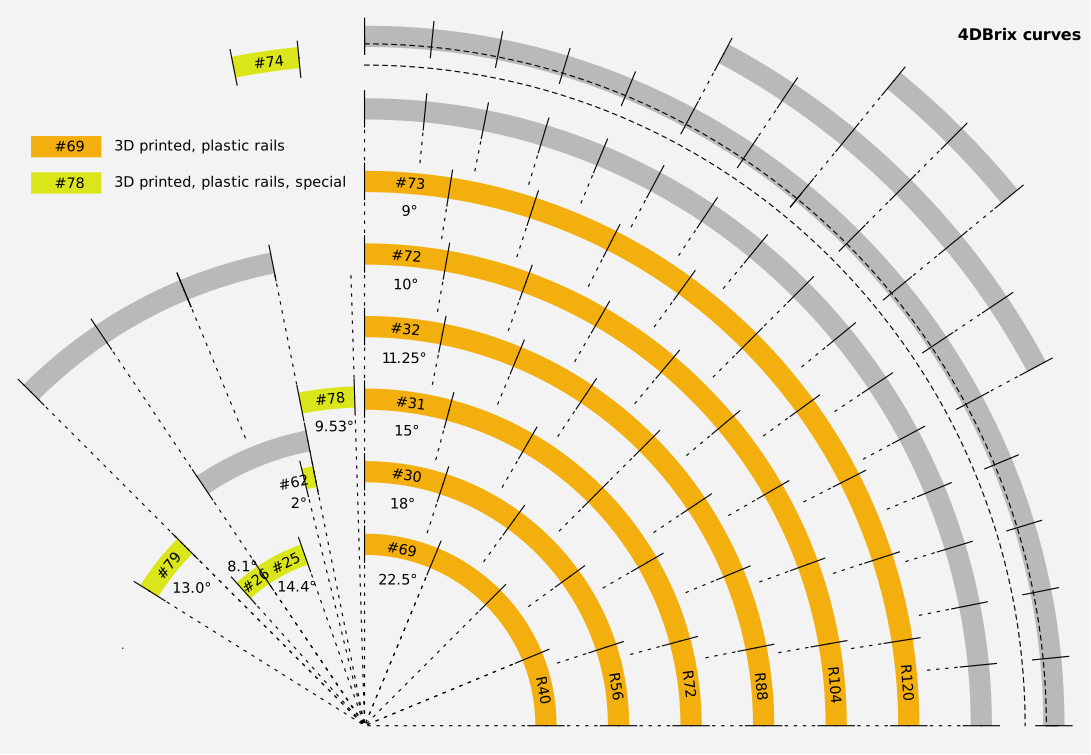
Curve-wise, these will all drive you (or at least your LEGO trains) round the bend. Click, tap or otherwise interact with the following images to see in detail what the seven manufacturers are currently offering, as of May 2024. (I’ve tried to be as accurate as possible in this post, but please check manufacturers’ websites before ordering any track!)
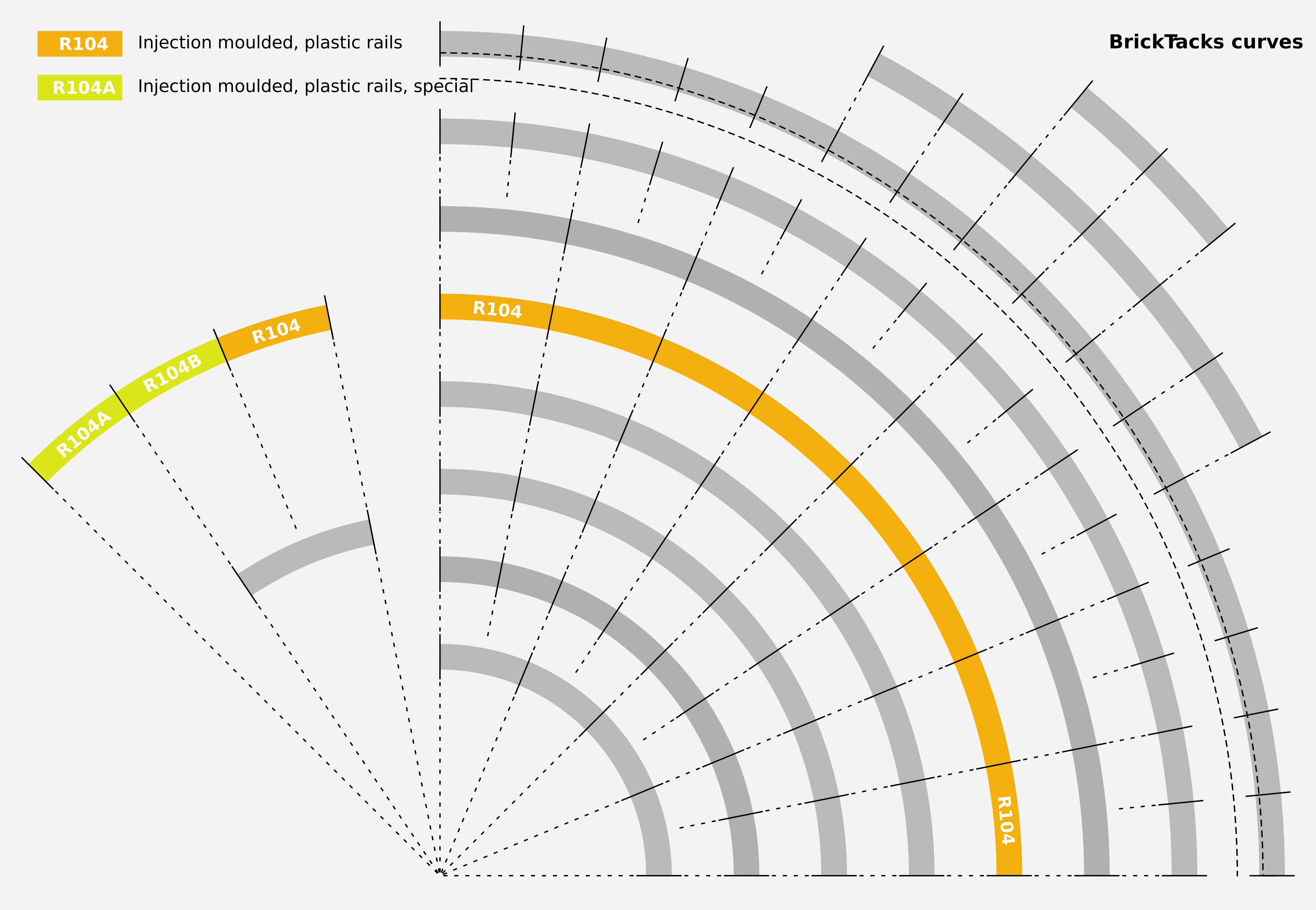
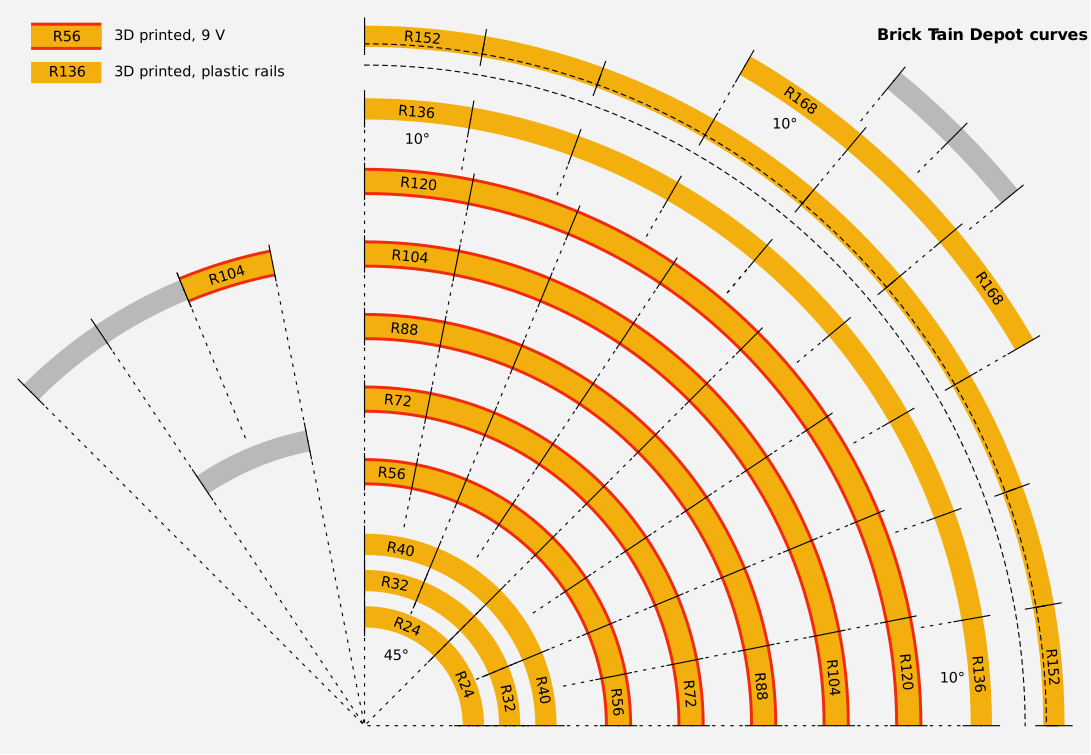
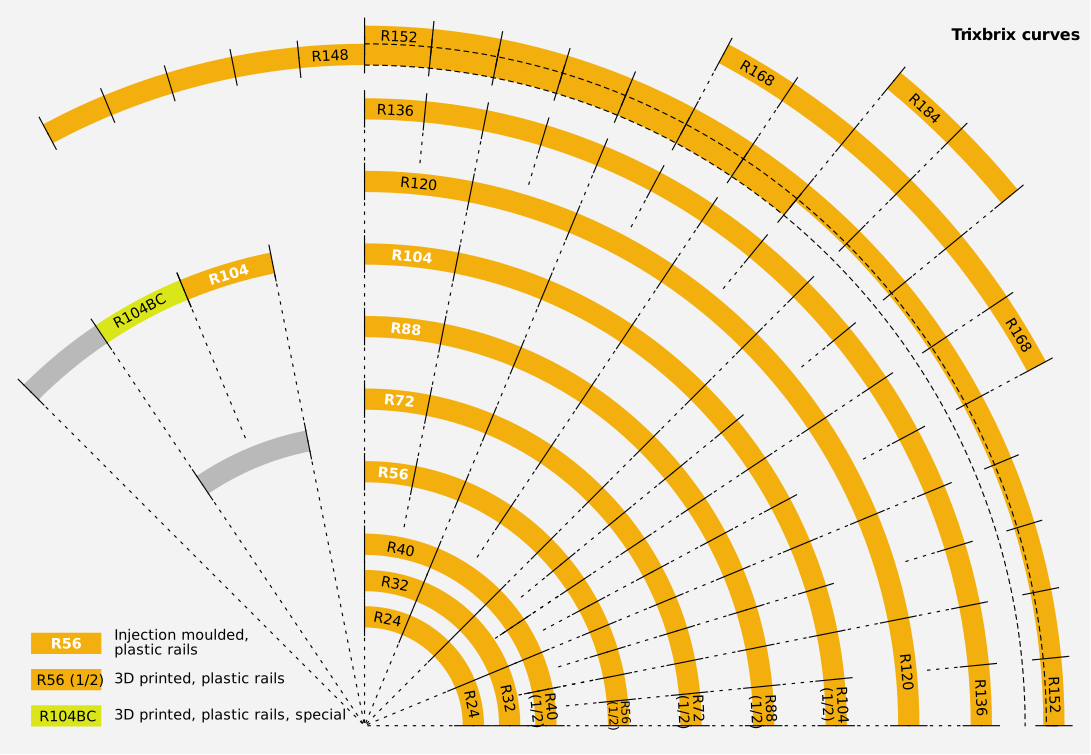
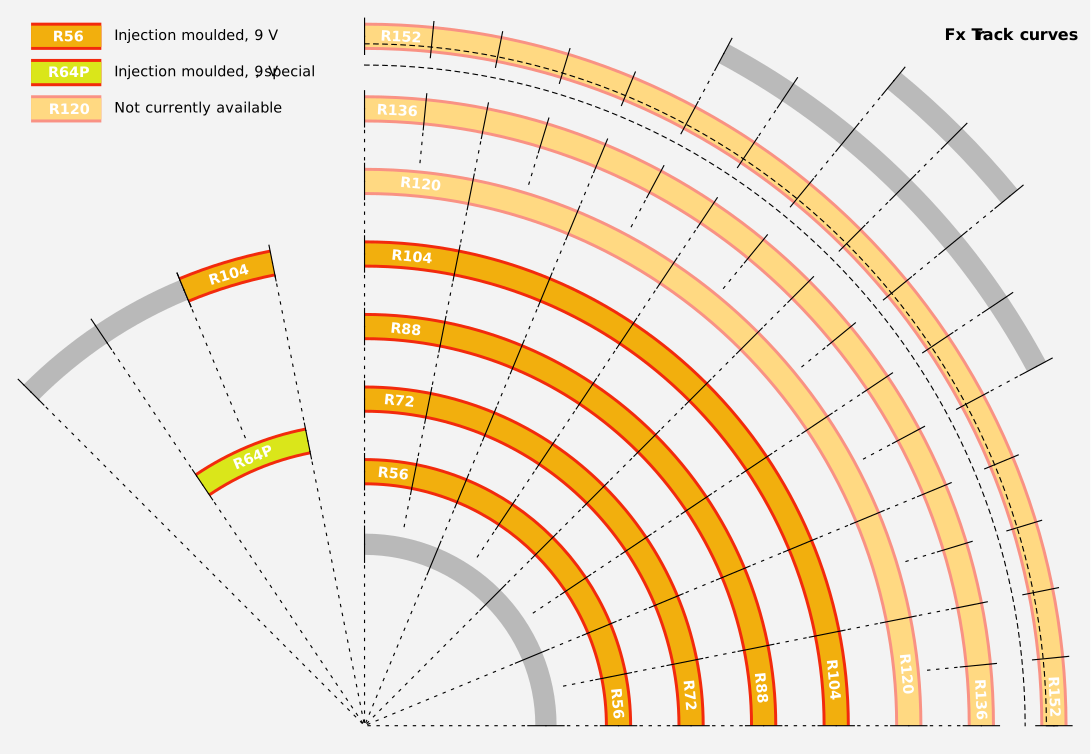
Some key things worth noting:
- Injection moulded track. All track made by LEGO, BlueBrixx, BrickTracks and Fx Bricks (Fx Track) is injection moulded, as are four of the curves from Trixbrix (R56 through to R104, but not the half lengths or the special ‘ballast curve’, R104BC).
- 3D printed track. The remaining curves from Trixbrix are 3D printed, as are all curves from Brick Train Depot and 4DBrix. 4DBrix is a bit of a special case, as they license 3D printing files for anyone to use, and there are several commercial printers who sell 4DBrix track (possibly of varying quality).
- 9 V track (metal rails). All track made by Fx Bricks is compatible with the old LEGO 9 V system, as are curves R56 through to R120 from Brick Train Depot.
- Plastic rails (for battery-powered, push-along or static trains). The remaining curves from Brick Train Depot have plastic rails, as do all track elements currently made by LEGO, BlueBrixx, BrickTracks and Trixbrix, as well as all track designs licensed by 4DBrix.
- Ballast. Adding ballast (or any other substructure) beneath curved track can be time-consuming and doesn’t yield perfect results. Trixbrix uniquely offers 3D printed ballast plates for (as far as I can tell) all of its track elements.
Once again, for completeness, I’ll consider LEGO’s flexible track, this time in its curvy guise. In theory, it can be shaped into any curve with a radius of at least 40 studs, though it might be difficult to constrain it to a particular curve in practice.
Though the inner rail becomes smoother as the curve is tightened, the outer one becomes more fragmented, giving the wheels on that side a very bumpy ride! Not only are there big gaps between the segments, but each segment is effectively a small straight track oriented in a slightly different direction from the previous one. So the wheels of a train are forced to make abrupt changes of direction every few studs.


That brings me to another option for making large-radius curves, as outlined by Holger Matthes in RailBricks 1 (2007), 32–33. This also involves approximating a curve using a number of straight segments that aren’t fully connected. But the segments can be much longer, typically 16 studs. Using a 1×2 jumper plate (3794 or 15573) and a 1×4 hinge plate (2429/2430), along with plain 1×1 and 1×2 plates, the connection on one side of the track is held apart by half a stud, as shown in the picture. (Apparently there is still a reliable electrical connection when using 9 V track in this arrangement.)


We can calculate the theoretical angle $\theta$ introduced between successive segments using a little trigonometry and algebra (mathphobes, skip to the last paragraph of this section!). I say ‘theoretical’ as there is always some wiggle room in practice. Setting the origin at the hinge point as shown, and measuring in studs, the point $A$ is at $(-\tfrac{1}{2},\tfrac{15}{2})$, while the point $B$ is the image of the point $(\tfrac{1}{2},\tfrac{15}{2})$ rotated clockwise about the origin through the angle $\theta$.

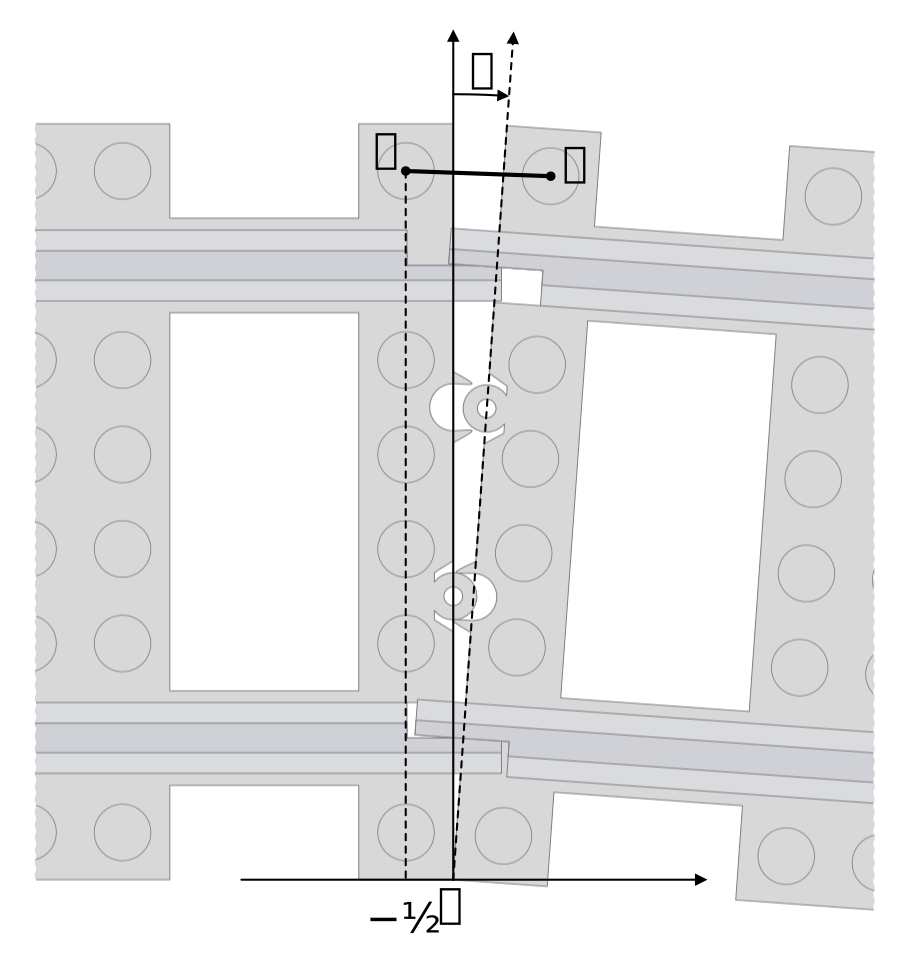
The point $B$ can be expressed as
$$\pmatrix{\cos\theta & \sin\theta \\ -\sin\theta & \cos\theta}\pmatrix{\frac{1}{2} \\ \frac{15}{2}} = \frac{1}{2}\pmatrix{\cos\theta+15\sin\theta \\ -\sin\theta+15\cos\theta}.$$
So we can relate $\theta$ to the length of the line segment $AB$, which we know is $\tfrac{3}{2}$, as the studs centred on $A$ and $B$ are held at this separation by a jumper plate. Squaring that length:
$$\frac{9}{4} = |AB|^2 = \left|\frac{1}{2}\pmatrix{\cos\theta+15\sin\theta \\ -\sin\theta+15\cos\theta}-\frac{1}{2}\pmatrix{-1 \\ 15}\right|^2.$$
This can be expanded and then simplified to
$$60\sin\theta \mathbin{-} 448\cos\theta + 452 = 9.$$
Since $\cos\theta = \sqrt{1-\sin^2\theta}$, this can be rewritten as a quadratic equation in $\sin\theta$, which can then be solved using the formula for quadratic roots. When we do this, we find that $\theta\approx 3.82$°.
That means a full ‘circle’ would require around 94 straights. If we approximate the circumference by simply adding the lengths of those 94 straights (with an extra quarter stud per join on the centreline), it works out to be about 1530 studs. Using the formula relating the radius of a circle to its circumference, we find that the effective radius is about $1530/2\pi\approx 240$ studs, which is around 1.9 m.
That’s certainly a bit grander than any of the curves available commercially (to my knowledge). Only Trixbrix’s 3D printed, plastic-railed R184 comes close, though I’d prefer to use a real curve whenever I could, as I’ve witnessed the jarring motion of trains working their way round these kinked pseudo-curves. Luckily, we have more options in 2024 than there were in 2007.
Pointy


If you’re wondering where the convention of spacing parallel tracks at 16 stud centres comes from, LEGO’s points (US switches) probably have something to do with it. One of the first LEGO train sets (if not the first) to include points was set 119, the ‘super train set’, released in 1968. It was so super that it included not only the almost obligatory oval for watching trains go round and round, but also a siding!
At that stage, LEGO points split one track into two parallel continuations, with one being offset to the side just enough – and no more – that it wasn’t actually on top of the other track. The points took up 32 studs in length.
When 9V track was introduced in 1991, LEGO changed the point design. The straight portion remains 32 studs long, and the curved track is still an S-bend, but it’s not quite complete: the outward turn takes a nominal 25 studs, as does the return curve, but 16 of the latter’s 25 studs require a separate R40 curve. With the addition of an S16 (a 16-stud straight) to the straight portion, the two tracks are brought back into alignment, now with centres separated by 16 studs.


But why might LEGO have chosen that 16-stud separation in particular? Warning: this is another mathematical digression – skip ahead if you wish.
If you want to make an S-bend, whether using points or otherwise, to move a track sideways, and you want to keep things as simple as possible, it makes sense to use two identical single-radius curves in succession, one turning out from the original alignment, and the other returning to the original direction but on the new alignment.

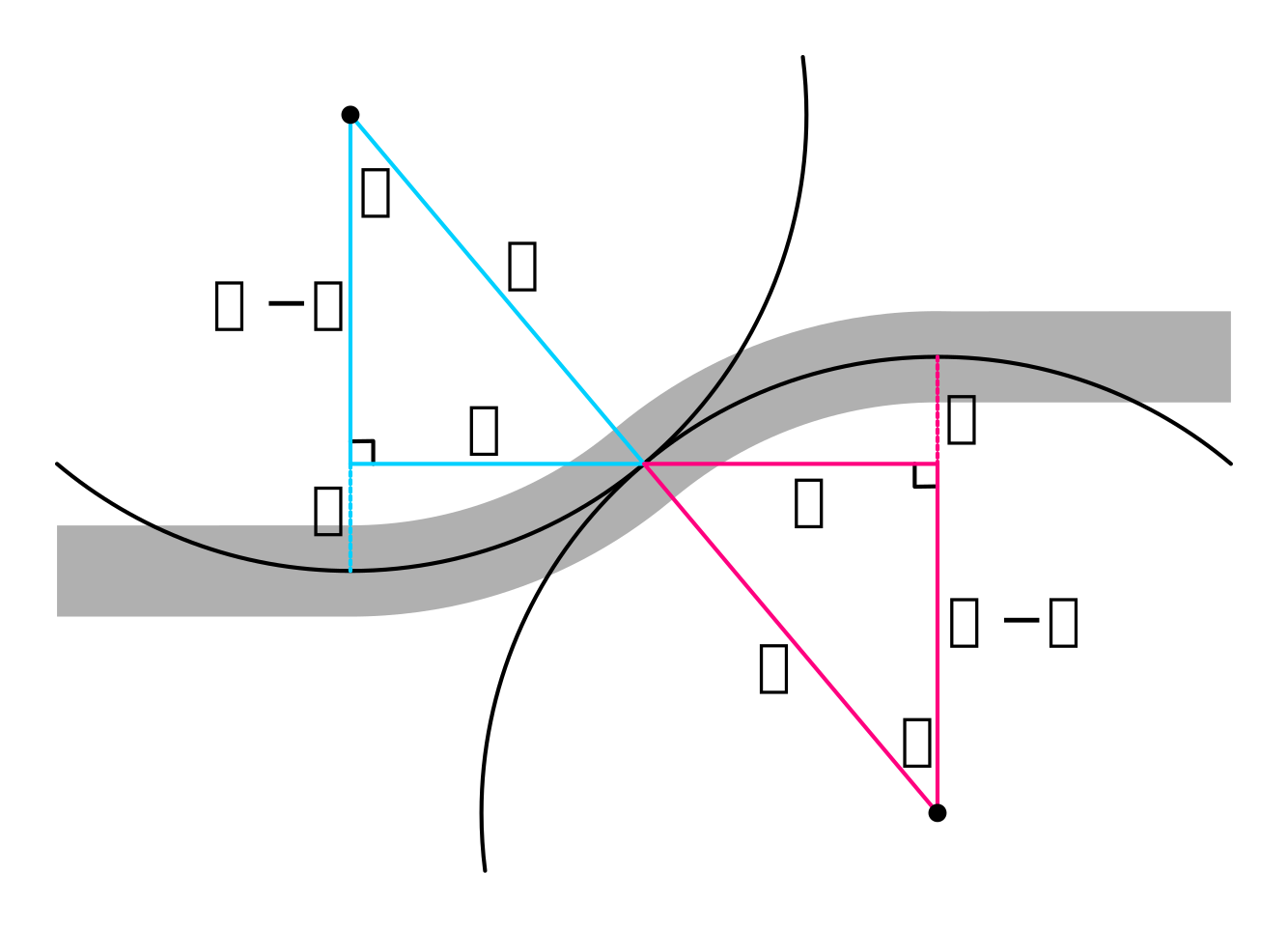
Suppose the element we choose has radius $R$ and angle of arc $\theta$, and that each curve moves us forward (in our original direction) by some length $l$, and sideways by some displacement $d$. We’d like $R$, $l$ and $d$ to be integral numbers of studs.
For all these numbers to be integers, the triangles in the diagram need to be Pythagorean. The first (primitive) Pythagorean triangle (that is, the one with the smallest hypotenuse) is the 3, 4, 5 triangle, but we know that the radius (which is the hypotenuse) is 40 studs, and 5 is a divisor of 40, so we can use the equivalent non-primitive 24, 32, 40 triangle, which gives $l=24$, $R-d=32$, and $R=40$ (so $d=8$). As it happens, this was LEGO’s choice. The length of a point (including the additional R40 and 16-stud straight) is indeed $2l=48$ studs (conveniently also a multiple of the 16-stud straight length). And the lateral displacement of the siding is indeed $2d=16$ studs.
Here $\theta=\tan^{-1}\tfrac{3}{4}\approx 36.87$°, so this kind of S-bend isn’t something that could be accomplished just using LEGO’s standard R40 curves, which have angle of arc 22.5°. LEGO’s points have a 36.87° arc in one direction, followed by 14.37° in the opposite direction, which has to be made up using that extra curve. Had LEGO chosen to make the cut at the midpoint of the S-bend instead, they would have been forced to introduce an additional return curve to match.
You may be wondering whether other Pythagorean triples would work for LEGO points and S-bends. And the answer is yes. For example (just choosing triangles with a hypotenuse that is one greater than the second longest side, to ensure that the 16-stud offset is maintained, and to maintain the curve radii as odd multiples of 8):
| Primitive triangle | $l$ | $R-d$ | $R$ | Length $2l$ | Offset $2d$ | Angle $\theta$ |
|---|---|---|---|---|---|---|
| 5, 12, 13 | 40 | 96 | 104 | 80 | 16 | 22.62° |
| 7, 24, 25 | 56 | 192 | 200 | 112 | 16 | 16.26° |
| 9, 40, 41 | 72 | 320 | 328 | 144 | 16 | 12.68° |
Despite revising the design of the points to increase the separation between parallel tracks, LEGO seemingly didn’t consider uses for points other than creating a parallel siding/sidings or perhaps a passing loop. In particular, it seems they never envisaged anyone wanting to have a main line with two or more parallel running tracks, or a branch line turning through a right angle from the main line.
For one thing, with only one radius of curve (unless you use flexible track), it’s not possible to have parallel tracks going round a bend. (Yes, you can get around it by inserting a few straights, but that’s a clunky and untidy-looking solution.)
Also, if you want a train to go from one track to another, you need a crossover, prototypically made from two points of the same handedness, their diverging routes connected. You can join two LEGO points like that, but at the expense of (a) losing the alignment of track joins, (b) having a much wider spacing between the tracks, and (c) needing four (!) alternating turns in quick succession to get from one track to its neighbour. (And even a 90° branch line requires three alternating turns!)
LEGO did make a double crossover, set 7996, emulating the kind of trackwork in the photo of Edinburgh Waverley station above, but that was in 2007, and it seems it was quickly discontinued.
If you’d find that useful, double crossovers with the same basic R40 design are now available from BlueBrixx (injection moulded), and from Trixbrix and 4DBrix (3D printed). All three have the advantage over the LEGO double crossover of allowing simultaneous running on both straight routes, rectifying a major failing of the original. Trixbrix also offer an R140 double crossover (which, as you might expect if you didn’t skip the maths, is 80 studs long). And 4DBrix’s ‘Ultimate Railroader’ components can be used to build an R148 double crossover.
For single crossovers, which are far more common on full-size railways, there are various options that avoid all the pitfalls of crossovers made from LEGO points (which really only have one application). Trixbrix has points that contain optional components, allowing them to be assembled in crossovers, or used for sidings or branches. These range in radii from R40 up to R120, plus the intermediate radius R148. 4DBrix has an R40 crossover matching its double crossover. You can also use its component system to build R56 and R148 crossovers.


Injection moulded parts from both Fx Bricks and BrickTracks can be used to build R104 crossovers. Both have return curves for parallel sidings (the Fx Track R64P, which I’ll come back to, and the BrickTracks 11.37° R104B, equivalent to Trixbrix’s R104 ‘ballast curve’). BrickTracks also has an 11.13° ‘turnout’ curve, R104A, which makes up the 22.62° turnout of the points to 33.75°, equivalent to three R104s. (This unfortunately has no Fx Track counterpart.)
It’s easy to get lost in the array of switches and crossings available, particularly those from Trixbrix. Some of their track elements, such as the star crossing (??), look like deviations from the prototype (please correct me if you’re aware of a real one!), but it’s nice to see things like slips, double slips and oblique diamond crossings – even if they’re best suited to people with enough space to model complex station throats. I’m not going to delve any deeper here, especially given that I have no practical experience of their track.
One thing that puzzles me about the Fx Track system is the use of S8 (an 8-stud straight) + R64P (a 22.62° curve of 64-stud radius) + S8 instead of something like BrickTracks’s R104B or Trixbrix’s R104 ballast curve (which together with an R104 make 22.62° curves of 104-stud radius). At first I thought this might be to provide a straight transition section between the turnout and reverse curves, but then the curved part of the point itself definitely has a radius of 104 studs, so a crossover for instance wouldn’t benefit from this. This combination of two straights and a tight curve just seems to get you from A to B by a slightly longer and less elegant route. (I got in touch with Fx Bricks to ask why they’d made this choice, but haven’t had a response.)
A couple of final points on, um, points. These relate to aesthetics/realism.


First, apart from Fx Bricks (and perhaps 4DBrix for their R148 points), all the manufacturers seem to emulate LEGO’s design when it comes to the switch rails, choosing (as far as I can tell) to shorten them on the straight route so that there is no point blade to close against the stock rail (presumably relying on the back of the other switch rail to act as a check rail?). I’d be very interested to hear from anyone who knows the reasons for this design choice. (Something practical to do with over-scale LEGO flanges perhaps?)
Second, only BrickTracks R104 and 4DBrix R148 points have anything approximating bearers – the extended sleepers that run from side to side under switches and crossings. As the PECO points illustrate, individual sleepers for the two diverging tracks don’t normally appear until beyond the crossing vee. Trixbrix seems worst in this regard, having some very odd things going on. Ideally, bearers would fit a whole switches-and-crossings assembly, as in the Edinburgh Waverley example at the start, where you can clearly see bearers perpendicular to the two platform tracks running from side to side under the whole crossover.
Curvature, transitions and cant

There are things I haven’t addressed in this post, and believe me, I want this to be over as much as, if not more than, you do! But I think I need to say something about the things I’m not going to say much about.
First, curvature. Curvature is a well-defined measure of the bendiness of any curve (within a flat plane). For an arc of a circle, its curvature is simply the reciprocal of its radius. For a straight line, it is zero. (There’s also signed curvature, which is positive or negative depending on whether a curve is turning anticlockwise or clockwise.)
Especially with LEGO and other model railways, we tend to talk more about radii, as we often use complete semicircles, which have an obvious centre. So it made some sense earlier to show curves of different radii in a diagram in which they were all concentric.
In many ways, though, it makes more sense to think in terms of curvature. In the diagram here, it looks as though the R40/R56 pair of tracks are much more tightly curved than the R72/R88 pair, and those are somewhat more tightly curved than the R104/R120 pair, and those are a little more tightly curved than the R136/R152 pair. The change in radius between each pair of tracks and the next is exactly the same, but it doesn’t look like it here. Curvature captures our intuition better.
Also, by adding the same number of studs to radii repeatedly, we’ll never get a straight line. So consider instead the sequence of curves R40, R50, R67, R100, R200, straight. The change of curvature between each curve and the next is the same: 0.005 per stud.
On full-size railways, engineers avoid kinks in the track leading to sharp changes in direction (as seen in flexible track and grand curves), and they also avoid sudden changes in curvature, especially at higher speeds. Jumps in curvature are felt as a jolt by passengers, and increase wear on wheels and rails. So even if straight tracks and fixed-radius curves are used, they are almost always connected by transition curves, originally based on the Euler spiral, which changes curvature linearly along its length.
Without using flexible track (which kind of defeats the purpose), we can’t accomplish that kind of subtlety in LEGO. But we could use higher-radius curves to approximate a transition curve, going from straight track to R56, say, by way of R184 and R88 (three roughly equal jumps in curvature. One of the difficulties of attempting this sort of thing is trying to stay within the LEGO System grid.
Finally, in real railways, mainline tracks usually have cant (US superelevation) on curves: anything up to around 150 mm increase in height of the outer rail compared to the inner rail (depending on line speed, curvature and types of trains using the line). This complicates the application of transition curves, but as LEGO modellers we probably don’t have to worry. Cant would take us into the third dimension, even if only by a plate or so, and this post is definitely 2D!
Thank you so much for taking the time to read this. I hope some of it has been useful and/or interesting. If you’re able to and would like to tip me for the price of a coffee, I’d really appreciate that. Comments, likes, shares and follows are also good!