
Whistling for dogs (transphobic ones)
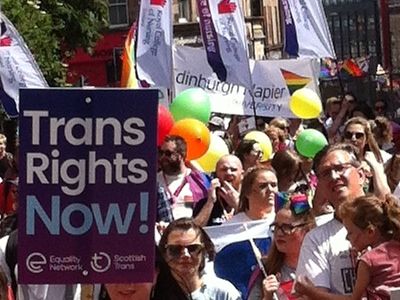
Trans rights now!
Vociferous transphobia has become endemic to parts of the UK media in recent months. (I’d love to know why, but I won’t speculate about that here.) Some of the articles that appear in the right-wing press, especially the tabloids, are so obviously full of hate that there’s no escaping the intent of the authors (or at least the authors’ paymasters). Other articles make superficially reasonable arguments about ‘competing rights’ (for women, children etc.) and pretend to be broadly sympathetic to trans people.
Across the entire spectrum of transphobic articles, there are distortions, half-truths and biased framings that crop up repeatedly. In particular, there are a number of dog-whistle phrases and tropes that are used over and over again. I’ve picked out a few of these from some articles over the past week or two – from a UK broadsheet, a Scottish newspaper (this is a much more recent phenomenon in the Scottish press) and a local newspaper.
Content warning: some of the following may be upsetting, in particular for trans people.
The Sunday Times
Andrew Gilligan’s article on women’s refuges (behind a paywall, with limited free access) is pretty typical of the almost incessant stream of transphobic – mainly transmisogynistic – bile that has spewed forth from the Times and Sunday Times over the past few months, often under the guise of feminism. Rupert Murdoch’s UK broadsheets outrank even the wretched tabloid Daily Mail as the reading matter of choice for those who have a visceral hatred of trans people and would really rather we didn’t exist.
-
biological men – referring to trans women. Yes, we may have been assigned male at birth, but we are women. Most people tend to be biological.
-
by women for women – referring to a change in who refuges are run by and for, strongly hinting that in the columnist’s view trans women are not women.
-
change sex on demand/sex-change – outdated and inaccurate language, with ‘on demand’ adding a slightly desperate note.
-
activists – transgender people who want to be treated as human beings are almost always ‘activists’, it seems.
-
male organs – you mean male kidneys, whatever they might be? Oh, you mean typical male genitalia. Why didn’t you just say so? And why should anyone care (or have an automatic right to know) about someone else’s genitals?
-
employment … without a gender recognition certificate – actually, an employer can’t legally ask to see a GRC.
-
staff who, to all intents and purposes, are men – the obligatory quote from a trans-unaware person, to make the views expressed seem more reasonable.
-
born female – referring to cis women – and implicitly excluding trans women.
The National
The first clearly transphobic article I became aware of in the Scottish press was an unpleasant piece by Shona Craven just over a couple of weeks ago in the National. (This is also behind a limited-free-access paywall.)
-
Women must not be silenced – the headline repeats the common mantra. Trans people are apparently so powerful in comparison to the cis majority that they are able to silence women (by which we are to understand cis women – trans women are presumably not thought to be silencing themselves).
-
held amid much secrecy … in case there was violence – a narrative is being spun, rather successfully, by a small group of cis feminists, that (cis) women are under threat from trans women (or ‘transwomen’ as they like to call us, like some alien species), because to them we are violent men trying to invade women’s spaces.
-
biological sex – much less black-and-white than most people think and not the same thing as gender. Isn’t feminism in part about not reducing women to their reproductive systems?
-
you must be a bigot … you should go and choke on a dick – random insults-to-self from no one in particular, to justify high-security cis-women-only events.
-
female biology – as an explanation for gender-based oppression.
-
boys can play with dolls and girls with cars – yes, we know, and I’m totally in favour of eliminating such gender stereotypes. But that’s really nothing to do with gender identity or gender dysphoria. A typical red herring.
-
cis lesbian – the only unacceptable identity in our culture, apparently. As a trans lesbian, I find that notion utterly bizarre.
-
“cis” – a term evoking ‘an audible hiss of disapproval’. Refusal to accept the term is akin to refusal to accept the existence of trans people. Saying you’re not cis, just ‘normal’, is akin to saying you’re not straight, white or middle class, just ‘normal’.
-
“drop the T” – yes, why not throw out this controversial element of the LGBT community (who only began the whole LGBT rights movement in the first place)?
-
“preferred pronouns” – scare quotes again. And, anyway, most trans people simply have pronouns, not ‘preferred’ ones.
-
total denial of material reality – a claim made by some about trans people. Reverting again to biological essentialism (and not even with a good grasp of modern biological understanding of sex).
-
hate … came from the individuals who shouted a woman down – typical portrayal of protesters (with a legitimate cause for concern) as hateful, shouty and misogynistic.
-
the word “woman” has no objective meaning – if the government’s GRA reform proposals go ahead, apparently.
-
young lesbian girls – at particular risk of losing protections, seemingly, though there is no mention of why. Perhaps an allusion to the laughable idea that cis lesbian girls are being recruited as trans boys?
-
Will they put their heads above the parapet to say so? – another allusion to women being silenced, in this case the unsupported allegation that non-trans-accepting women working for Engender, Close The Gap, Rape Crisis Scotland, Equate Scotland, Scottish Women’s Aid, Women 50:50 and Zero Tolerance are afraid to speak out for fear of losing government funding.
More recently Vonny Leclerc has written an article on gender and feminism for the same paper. I have generally enjoyed her contributions, so I found some of her language here slightly disappointing. But I like to give her the benefit of the doubt, as her words suggest she is genuinely wrestling with the issues – and on the whole the article is rather good.
-
TERF [is] a slur – a common cry from people who are labelled in this way. OK, the term (meaning trans-exclusionary radical feminist) is problematic (mainly because you have to diagnose radical feminism to use it properly), but when used accurately it’s no more a slur than ‘racist’ or ‘misogynist’.
-
born female – offence was (quite reasonably) taken when Leclerc used this expression in a tweet. See above.
-
natal women – a term, along with ‘women born women’, typically used by cis feminists who refuse to accept the neutral word ‘cis’. Cis women and trans women alike were born as babies, not women (thankfully!).
Edinburgh Evening News
This local newspaper has a tendency to become fixated on populist topics (trams and Gaelic are a couple that spring to mind – both portrayed as a waste of money) and is generally notorious for attracting a rabid commentariat on its website. The articles can be bad enough, but for your own health you should never read what’s beneath them. Opinion columnist Susan Dalgety’s article last week (‘My problem with men who self-identify as women’) was a particularly nasty excursion into the topic of gender identity.
-
men who self-identify as women – in the headline. This sets the scene for the article, really.
-
a slash of red lipstick and a pair of New Look heels – a transmisogynist trope of the first order to get the article under way.
-
confused young man – after all, what else could trans people be other than confused?
-
sudden sex change – outdated/inaccurate terminology for transition. And sudden? There’s nothing sudden about transition, as any trans person will tell you.
-
labelled a TERF … need to lock her social media account – yes, well, if you abuse people on social media, you should probably expect to be called out for it (though, as I said above, ‘TERF’ isn’t always accurate).
-
… lobbed at women on Twitter – makes it sound like unbridled misogyny, though the term ‘TERF’ is usually only used of people who are dismissive of trans women’s lived experience.
-
more than a love of lippie to make a boy a girl – as we all know (but why not make it sound as though this is what trans women are all about?).
-
sudden influx of young male millennials who are self-identifying as women – let’s stop calling young trans women ‘male’, and it’s not really a sudden influx, is it? (And why the pop at millennials?)
-
sisters who have fought so long and hard for equal rights – yes, why should young trans women benefit from this? Maybe for the same reason that young cis women deserve these rights despite not having fought long and hard either.
-
if he changes his name from [deadname] to Lily – deliberate misgendering and deadnaming of an individual trans woman (in this case Labour Party women’s officer Lily Madigan).
-
… and slips into a size 12 frock – oh, for goodness’ sake!
-
[invading] a bloke’s privacy – talking about the current requirements of the GRA for medical diagnoses. Not ‘a person’s privacy’ – no, because we’re still fixated on trans women, and still calling them men!
-
wait till he has a smear test, or gives birth, or … Oh wait, that won’t happen. – misgendering again and suggesting invalidity of trans women’s claims to womanhood. Oh, and hurting those women, cis and trans, who would love to be able to give birth but can’t.
-
trans men joining the all-women lists – um, you mean trans women, don’t you?
-
call me old-fashioned, naïve, or even transphobic – OK, I’ll go for transphobic. I think you’ve earned it.
And … breathe
I try not to read too many trans-hate articles, but every so often I dip my toe in this media mire – if only to check whether it’s still happening. I did read each of these articles earlier, but re-reading them to put this post together was still quite an unpleasant experience for me. If any trans-unaware person reads this and gets a sense of some of the dog-whistling that is going on around trans issues at the moment, my post will at least have served some purpose.
Comment from WordPress
[2018-02-08 02:19:12] Laura Vivanco: I think, despite my best efforts to inform myself, I still count as a fairly “trans-unaware person.” I’ve got lots of thoughts and questions and, since you said on Twitter it was OK to put them down here, I’ll do that. This is an extremely long comment, but since you seem to be alright with that, here goes.
I was wondering if you could elaborate a little bit firstly on the “red herring”:
—-“boys can play with dolls and girls with cars – yes, we know, and I’m totally in favour of eliminating such gender stereotypes. But that’s really nothing to do with gender identity or gender dysphoria. A typical red herring.” —
I can see how bringing up dolls and cars is a red herring if your gender identity is not based on gender stereotypes but I’m not sure exactly what “gender identity” is. Could you explain that a bit? I noticed that in Vonny Leclerc’s “on the whole […] rather good” article she sets up two feminist positions (I’ve put a number beside each statement I think she’s attributing to each of the two positions):
—-There is a tension between feminisms right now and it’s about the conception of gender. That is, whether you understand it as [1] socially constructed based on biological sex, functioning as an oppressive hierarchy and the backbone of patriarchy – or [2] conceive of it as an innate sense of self that can differ from your sex, that pursuing can free you from the limits of the gender binary.
One conception [1] advocates liberation from the things we code as gendered, making room for masculine women, feminine men, and everything in between. The other [2] advocates for identity, presentation and self-expression as a means of freeing oneself from bondage to the expectations of your sex. One side [1] rejects “girl” things and “boy” things’; the other [2] sees preferences as indicative of a true gender that conflicts with sex. Feminists have long fought to be free of expectations. What is liberation to one camp is oppressive to the other. —-
So, if position 1 is about liberation from gender, that presumably would include something like
—-One is not born, but rather becomes, a woman”‘-Simone de Beauvoir’s formulation distinguishes sex from gender and suggests that gender is an aspect of identity gradually acquired. The distinction between sex and gender has been crucial to the long-standing feminist effort to debunk the claim that anatomy is destiny. (from Judith Butler: https://www.jstor.org/stable/2930225?seq=1#page_scan_tab_contents )—-
Now, if that’s position 1, I don’t see how anyone believing that could legitimately exclude anyone who says they’re a woman from a meeting for women. After all, if everyone who is a woman “becomes” one, there shouldn’t need to be an argument about how/why any individual person became so. So position 1 is presumably not a trans-exclusionary position, at least not if it’s taken to the conclusions Butler takes it to. So maybe there are really three positions in feminism and Leclerc has left out one which takes “biological sex” (however that’s defined) as the sole determinant of whether someone is a woman? Anyway, on to position 2. I have a feeling this is where your red herring comes in, to do with “gender identity or gender dysphoria” because I’m not sure where a “true gender” comes from and I’d think of “an innate sense of self” in individualistic terms as a “personality.” This means I feel something important is zooming past me without me having noticed it (as I said, I think I count as “trans-unaware” despite my best efforts).
I’ve been thinking that there is biological sex (and as Julia Serano writes in a post you linked to recently ( https://medium.com/@juliaserano/transgender-people-and-biological-sex-myths-c2a9bcdb4f4a ) there are more than 2 and it’s not as simple as people think to know what anyone’s is) and there’s gender, which I think is something created by society, so (a) there are two genders (usually, though some societies have more) and each gender is assigned particular characteristics/preferences/abilities and (b) we all have unique personalities, and so (c) we’re kind of forced to work out which of the existing genders most closely matches our personality and if our personality doesn’t fit the one we were assigned at birth due to our (perceived) sex, that makes living life in that gender feel really fake and false to oneself. I think that must mean I’m basically taking position 1 (unless I’m misunderstanding Leclerc, which is possible).
Maybe I’m falling into what Serano listed as
—-The “mind/body” dualism fallacy
The gender/sex distinction is rooted in mind/body dualism, which was once commonly accepted, but has since been rejected by contemporary biologists, cognitive scientists, philosophers, and psychologists (as well as many feminists!).—-
I admit it is a distinction which makes sense to me (even though I’m well aware that brains are not separable from bodies) because I do believe in souls, and I’m sure a lot of “contemporary biologists” etc have rejected that concept too. However, on the topic of contemporary biologists I did see that the Endocrine Society recently stated that there’s “a durable biological element underlying gender identity” (https://www.endocrine.org/advocacy/priorities-and-positions/transgender-health ). That said, if both 1 and 2 are in agreement that gender stereotypes are wrong, there’s presumably agreement that there’s a wide spectrum of possible outcomes even from similar biological inputs and, as Cordelia Fine argues (in a post written some years before the Endocrine Society’s statement),
—-drawing a link between brain differences and psychological or social differences between the sexes is no easy task. This is partly because those gender gaps can close or even disappear depending on social context, place and historical period. But also, we are still at the beginning of the journey of understanding how the brain enables the mind. Even if we assume that a sex difference in the brain is reliable – generally not a safe assumption to make – what does it mean? The sheer complexity of the brain, together with our assumptions about gender, lend themselves beautifully to over-interpretation and precipitous conclusions. ( https://thepsychologist.bps.org.uk/volume-23/edition-11/battle-sex-differences )—-
Since this is not an area in which I have any expertise, I’m going to have to move on to something else without reaching any firm conclusion. Serano also writes (at http://juliaserano.com/terminology.html#subconscioussex ) about
—-Subconscious Sex: a term I coined in Whipping Girl (pp. 26-29, 77-93) to describe an unconscious and inexplicable self-understanding regarding what sex one belongs to or should be. I felt the phrase was necessary to distinguish between these unconscious experiences and the more conscious way we make sense of such feelings (i.e., what we typically call gender identity). Furthermore, the word “identity” makes itI purposefully used the word “subconscious” (which is ambiguous and rarely used in academic/research settings) to capture the vagueness of such feelings (at least as I experienced them) and to avoid making it sound like I believe that they resided in a specific gene or region of the brain. And I intentionally used the word “sex” (rather than “gender”) to reflect the fact that for many transsexuals (including myself) the desire to transition is often driven by sex embodiment (i.e., aligning our subconscious and physical sexes) more so, or in addition to, a sense of sex/gender affiliation (i.e., belonging to and being recognized as a member of that sex/gender). I also argued (in the cited passages) that cissexuals also likely have a subconscious sex, but they tend not to notice or appreciate it because it is concordant with their physical sex (and therefore they tend to conflate the two); this helps to explain the strong knee-jerk negative reactions some cis people exhibit toward transsexuals and the very notion of physical transition.—-
It does strike me that if, as Serano suggests, there’s something that trans people have experienced with regards to gender/sex that cis people haven’t, maybe that’s why there’s a comprehension gap between the two positions outlined in Leclerc’s article: it’s to do with feelings/the subconscious and therefore people who hold position 1 and haven’t felt/experienced it will just have to accept that people who hold position 2 have. There doesn’t seem much point arguing about it, because it’s about experience not logic/evidence. Again, since I believe in souls, this is not a big problem for me personally: I believe in lots of things for which there isn’t much logic/evidence and I don’t believe that in itself disproves them. I can’t necessarily believe what others believe in just because they tell me about it, but I can respect their beliefs.
And as if that weren’t enough questions/ponderings, I’m also wondering how/where nonbinary/agender/nongendered people fit in with regards to position 2 (and being clueless, I’m sure there are lots of distinctions to be made between these terms, but I feel like I’ve blundered around enough by myself on this topic and need a bit of a steer in the right direction).
- ← Previous
GRA reform in Scotland – 3: the need for change - Next →
Our Tribe: coming out